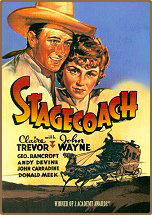
If there is one movie that defined
the great American Western, one movie that set
all the standards for the genre that would be
the keystone of cinema for almost forty years,
then John Ford's Stagecoach
is that film. Starring a very young John Wayne,
Stagecoach arguably
one of the greatest Westerns ever filmed.
The film tells the story of, well,
a stagecoach. The wooden wagon faces a myriad
of trials and tribulations as it attempts to traverse
Apache territory to get to a small settlement
across the desert. On the coach are a mix of interesting
characters, including a drunken doctor (Dr. Boone)
and a prostitute (Dallas) who were both run out
of their town by a group of conservative women.
Also populating the small coach are a banker who
robbed his own establishment, a Southern gentleman
gambler, a young woman (Lucy) looking for her
soldiering husband, and a whiskey salesman named
Mr. Peacock.
Buck drives the coach while Sheriff
Wilcox rides shotgun, on the lookout of Geronimo's
angry Apaches and a young man called "the
Ringo Kid" (Wayne) wanted by the law. The
U.S. cavalry accompanies them part of the way
across the mid-west when they run into Ringo,
without a horse and looking for a ride. Wilcox
and Ringo come to an understanding that he is
under arrest, but will remain unbound in case
they need him to use a rifle.
Ringo it seems is the only person
besides the drunken Dr. Boone (incidentally played
by Thomas Mitchell who also stars in Secret of
the Incas) who shows Dallas any respect as a lady.
The rest of the party treats her like a dirty
whore. They arrive at fort after fort, stopping
to rest, all the while discovering that Lucy's
husband is always one step ahead of the stagecoach.
On the last leg of their journey, the Apaches
rear their deadly heads and everyone knows it
will be a frantic fight to the death. Even if
they survive, Ringo knows that at their destination,
Luke Plummer and his two brothers are just waiting
for him to get off the stagecoach so they can
gun him down.
John Ford defined the Western with
this film. In this one story, all of the now-cliché
devices are present for the first time. There
is Dallas, the whore with the heart of gold and
Ringo the misunderstood, noble outlaw. There is
the sympathetic Sheriff and the lovable, if a
little cowardly, coach driver as well as the gentlemanly
Southern gambler and the fish-out-of-water traveling
salesman.
While the film seems rather tired
now to modern audiences, keep in mind that this
film started it all for the Western, and was truly
revolutionary. There are some truly powerful sequences
in this film, most notably the moments in which
Dallas must deal with the prejudices of others.
The cinematography is amazing, director John Ford
opting to shoot the majority of the exteriors
on location in Monument Valley, Utah. Even the
back lot scenes in the towns are expertly crafted
with the final duel between Ringo and the Plummers
looking simply breathtaking.
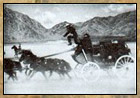
Yakima
Canutt doing his
Stagecoach
stunt. |
|
Indiana Jones borrows much from
Stagecoach. Pioneering
stuntman Yakima Canutt was responsible in this
film for the stunt that inspired the climax of
the truck chase in Raiders
of the Lost Ark, in which Indy goes under
the truck. In the film, an Apache warrior attempts
to stop the stagecoach by jumping onto the two
lead horses. Ringo spins from the roof of the
wagon and shoots the Apache with a rifle, sending
him down between the horses, where he slides underneath
the wagon and away from the coach. Granted, the
character was supposedly dead, but the stunt was
awe-inspiring. Yakima would go on that same year
in the serial Zorro's
Fighting Legion to make the stunt complete
by sliding under the coach and then catching it
on the other side, only to work his way back to
the front.
The other influences Stagecoach
had on Indiana Jones were in the areas of atmosphere
and cinematography. In the opening of Indiana
Jones and the Last Crusade, it is impossible
not to see the visual parallels with Stagecoach
as the Boy Scouts ride gently through amazing
desert landscapes in Utah much like John Ford
achieved in so many of his films. When the stagecoach
finally arrives at the town in the middle of the
night, battered and bruised, Indy fans may notice
similarities in the lighting scheme of the town
to that of the scene in Raiders
of the Lost Ark in which Indy and Marion
are parting with Sallah at the docks.
If you have not seen Stagecoach,
you are missing one of cinema's signature moments,
a true earmark in the history of storytelling.
(MF) |