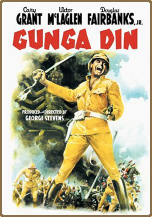
While it is well known that the
serials and adventure films of yesteryear inspired
the Indiana Jones series, the film Gunga
Din falls into a very unique place in the
library of movies that George Lucas and Steven
Spielberg used as templates for Indy's adventures.
Certainly, Gunga Din
was a major influence on the films, but it is
the only film that can boast to being a prequel
to the Indiana Jones adventures as well.
Yes, you read correctly. A prequel.
While it cannot officially claim to be said prequel,
there's enough evidence in the story itself to
justify such a claim. In Indiana
Jones and the Temple of Doom, the British
captain tells Indy at dinner about the decimation
of the Thuggee cult by the British army some years
before. Well, Gunga Din
is essentially the story of that first encounter
with the cult of Kali.
The story takes place in late 19th
century India. Three fun-loving, fist throwing
members of Her Majesty's army, Archibald Cutter
(played by Cary Grant), Tommy, and Mac, are sent
with their commanding officer to a remote village
where they find the entire population has vanished.
They find an axe and identify it as a Thuggee
weapon. Just as they realize that the evil Thuggee
cult is behind the destruction of the villagers,
the forces of Kali attack. A frantic battle ensues,
but Archibald and his friends manage to fight
off the Thuggees with the help of their Indian
soldiers and a particularly brave servant named
Gunga Din.
Gunga Din tells Archibald of a great
temple hidden in the mountains made of gold. Archibald,
obsessed with finding the gold, steals off into
the night with Gunga Din to find the treasure.
When they arrive at the temple, they find the
Thuggee waiting for them instead. So begins a
great, harrowing adventure with spirited hokey
lines and crazy action, much like Temple of Doom.
The similarities to the second installment
of the Indy series are so obvious you'd have to
be asleep to miss them. The film opens with a
man banging a gong, exactly like Temple
of Doom. There are the Thuggees, who make
time out in the film to worship Kali while Archibald
and Gunga Din look on, much like Indy and Shorty
do in the "future". The next striking
similarity is the leader of the cult, who looks
exactly like an ancestor of Mola Ram. He is bald
with ceremonial robes, a creepy gaze, and that
eerie, cryptic, threatening voice. Near the temple
in the film is a rickety rope bridge, much like
Temple of Doom.
Cutter even has a debacle of a scene with an elephant,
which reminded this writer of Willie's own difficulties
with those pesky packederms.
With all of these obvious similarities,
what amazed me the most about how Temple
of Doom paid homage to this thirties classic
was the parallel between the attitudes of Archibald
Cutter and Indiana Jones in these films. Archibald
has a "Damn the torpedoes, full speed ahead!"
attitude throughout the film. He risks everything
to find the golden temple, even risking the lives
of his friends all for, dare I say, "Fortune
and Glory". In Temple
of Doom, Indiana Jones is similarly after
the fortune and glory of the quest. Indy does
not actually have to go find the stones and risk
the lives of Willie and Shorty, but he does for
the sake of self-satisfaction. Luckily, for both
Jones and Cutter, they also manage inadvertently
to put a stop to the Thuggee during their adventures,
with a little help from the British Army.
If you are in the mood for an adventure
film in the spirit of Indiana Jones, then look
no further than Gunga
Din. The movie spins an excellent yarn
of three gung-ho soldiers against the evil of
the Thuggee. Cary Grant, for lack of a better
term, is a hoot in this film, and reminds me of
a cross between Indiana Jones' more reckless persona
in Temple of Doom
and Jack Burton (Kurt Russell's character) in
Big Trouble in Little
China. Archibald Cutter reeks of manly
bravado and fearless fervor, while at times it
is plainly and humorously obvious he has not a
clue what he has stepped in. His introduction
in the beginning of the film is priceless in and
of itself.
The film is filled with action of
the highest caliber that 1930s cinema could deliver.
The fight in the village alone makes this film
worth watching.
If you are an Indy fan, and especially if you
are a Temple of Doom
fan, see this film! You'll be doing yourself a
favor. (MF)
|