| How did you become interested
in video games and video game design? The
short answer is, I was always interested in games,
but because I grew up in an era before personal
computers existed, I followed another dream instead
-- making movies. When the Apple 2 arrived, I
taught myself assembly language in order to build
a game -- a long, complex RPG/adventure called
Space Snatchers.
Eventually some people at what became LucasArts,
who knew about my Apple game, invited me to lead
a Jones project. Well, my latest script hadn't
sold, and it sounded like the time was ripe.
What is the major difference
between writing for a film and writing for video
games?
Major difference? I dunno, there
must be ten or more. First, games are interactive,
so dialog must have multiple variations. Next,
movies are like short stories and games are like
long Russian novels, so the plots have more twists
and turns and scenes, and you have to work a lot
harder to get them done. Then, a moviegoer doesn't
absolutely have to know what's going on -- movies
pull you through the climax automatically, so
writers obey all the rules about minimizing and
concealing exposition; but games demand that players
work through the narrative, and if they don't
understand it, they get lost and it never ends.
So some of the writing has to be instructive.
There's more, but it's like magic tricks -- when
you reveal how things work, you bore people.
You have written a variety of
films, from Spielberg's earliest dramatic work
in The Sugarland Express
to high fantasy in Dragonslayer
and even light comedy in the case of Corvette
Summer. What did you learn from these experiences
and did you bring any of that legacy into your
video game career?

Original Dragonslayer
film poster (1981). |
|
Screenwriting is a great teacher.
I learned how to compress story material, how
to squash it until it yields up the strong elixir
of expressivity, like pressing grapes to get wine.
I learned how to think about plot and character
and conflict. I learned that being creative in
a commercial environment is a rocky road. And,
maybe most important, I learned how to be a professional.
How did the gaming industry differ
when you began working versus today?
The worst of the past? Everything
was primitive then. Computers were slow, graphics
were crude, most developers that were attracted
into the business had fewer skills. As Will Wright
often puts it, more of a game was in your head
than in the computer. And the best? Well, those
games all sold pretty well. Developers didn't
have to worry as much about hits back then: if
you made something and did a decent job, it would
find a paying audience. More important, I think,
is how little the underlying forms and genres
from those days have changed.
Point and click adventures dominated
computer-based gaming for so many years, and with
titles like Fate of
Atlantis and Don Bluth's Circle
of Blood, seemed to be getting better and
better into the mid-1990s. Why did point and click
fade at its zenith and what are your feelings
about this shift?
Judging from my experience at LucasArts,
I suppose they faded because they didn't sell
very well, especially compared to rapidly rising
costs as graphics and audio became more and more
sophisticated.
What are the demands placed on
game designers today?
Well, you're always trying to dream
up the ingredients for a hit. But beyond that,
design has become a job category, and it's rare
that the designer is also the director or producer
of a project. So fitting into a team has become
all important. That's both good and bad; it means
we take advantage of the "hive mind,"
but it also means a loss of personality in the
games we make.
Do games now have to cater to
shorter attention spans?
Don't I wish! Four hours, max! Unfortunately,
games are generally priced higher than an impulse
buy, so players (or their shopping mothers) look
for play value of many, many hours. Personally,
I'm almost always bored with games by the time
I finish them -- generally speaking, they don't
seem to have enough oomph to actually fill those
long hours with continuous creativity. There's
a lot of fodder. Maybe that's why, in contrast
to the way they tackle books and movies, few players
finish what they start. But oddly, games are also
better now on average. Back in the early days,
if you found a good game you wanted it to last
eternally, because you strongly suspected that
what came next would be a gobbling turkey. Nowadays,
I see a lot of good games I want to play, and
length gets in the way.
What are the new "design
trends," mandates and challenges?
I'm lost on this one. I don't think
they've changed much over time, except 3D graphics
and multiplayer opportunities have opened up a
lot of new possibilities to explore. I guess I
wish for more change than I see: if no one ever
made another first-person shooter, I wouldn't
mourn.
In recent years, point and click
style adventures have slipped back into game store
shelves with titles like Runaway
and Broken Sword 3,
the latter of which combines 3-D game play with
point and click-style puzzle solving. Is there
a chance "point and click" style adventure
gaming could make a comeback?
Hooray! Yes, we see something of
a renaissance in Europe, and a few titles here
in the states as well -- go, Sam
'n' Max! Why this is, I have no clue. I'm
guessing it may be tied to the rise of casual
games -- there's a large demographic out there
eager to play games, but not with the intensity
needed for what some call "AAA titles."
Maybe they're migrating over to the new adventures.
I hope so.
What is the most satisfying project
you have worked on?

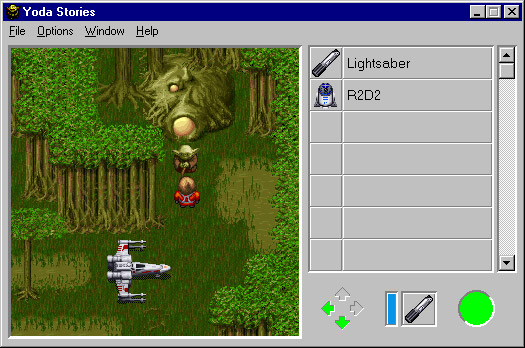
Hal's Yoda
Stories
game screenshot. |
|
I love 'em all. But I guess a little
"desktop diversion" called Yoda
Stories is right up there: it was a casual
game before that term was invented, a replayable
story/action/adventure game system that still
amuses me to this very day, in spite of its dated
graphics.
What is your favorite game style
to design for?
Action-adventure, character-action,
whatever you want to call it: games with real
danger, real exploratory components, combat, and
a strong dramatic storyline.
When you begin work on a game,
what is your creative process like?
The real answer is, it's never the
same way twice. Sometimes I've been given a character
(e.g., Indiana Jones and Mata Hari), sometimes
I've thought of a narrative premise that looked
promising, sometimes a mechanic has suggested
a game wrapper. It's like driving in the rain
at night: you have to be alert for surprises,
and hope you arrive safely.
When you started work on Fate
of Atlantis, what was your biggest challenge
throughout the design process?

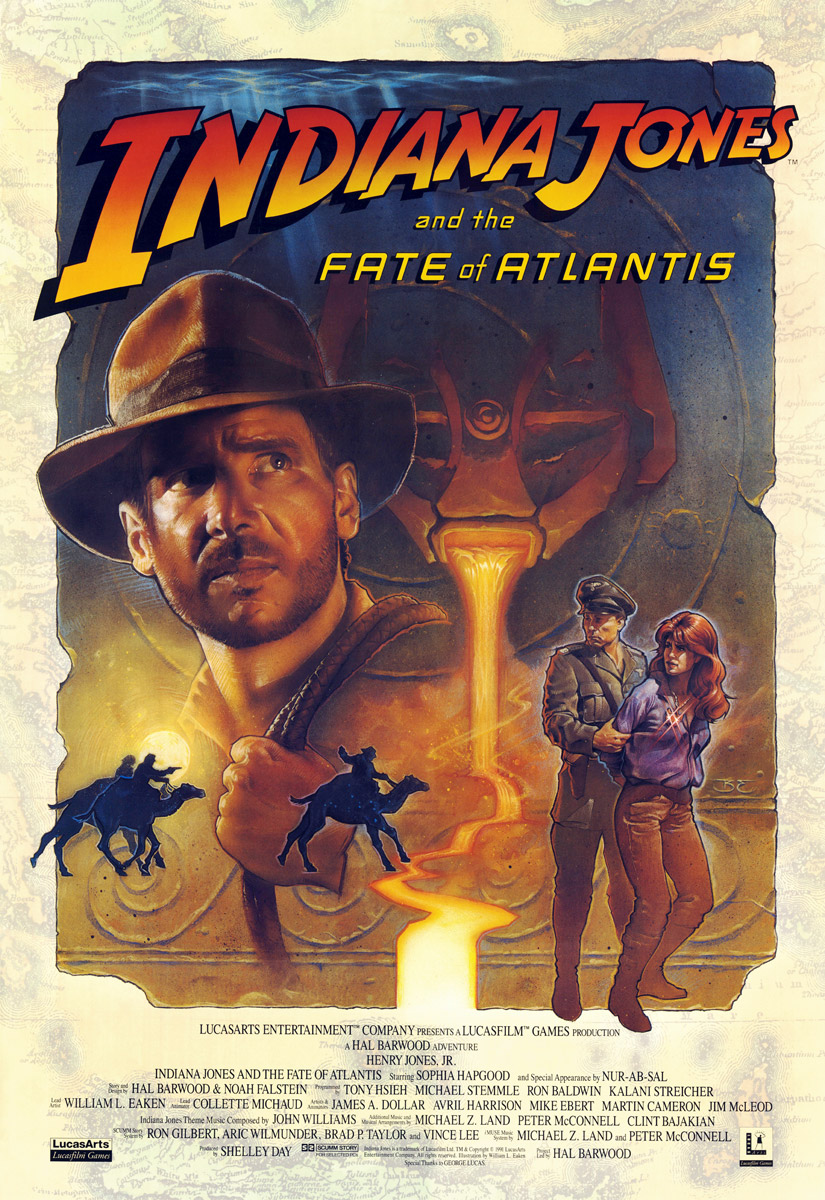
Fate
of Atlantis
poster. |
|
On-the-job training! It was my first
pro gig. Thanks to help from Steve Arnold, Ron
Gilbert, David Fox and especially Noah Falstein,
things went well. Once I got going, I think the
toughest challenges were to execute the three-path
structure Noah and I agreed on, and to convince
the LucasArts
elders that allowing the hero to get killed, although
contrary to their House Design Rules, was absolutely
essential to an Indiana Jones game.
Was there any part of the process
where you felt too constrained, either by technological
limitations or narrative challenges?
All the time. Technical limitations
'r' us -- hey! -- Fate
was both the first LucasArts
game to employ as many as 256 colors, and the
first to make use of practical, if primitive,
voice technology. Ooooh. And, Fate
was the first LucasArts
game to be produced in a modern accounting regime,
with budgets under scrutiny and much-needed resources
often withheld by management, bless their wicked
souls.
What was your knowledge of Indiana
Jones up until that point and what inspirations
did you draw from to construct the game?

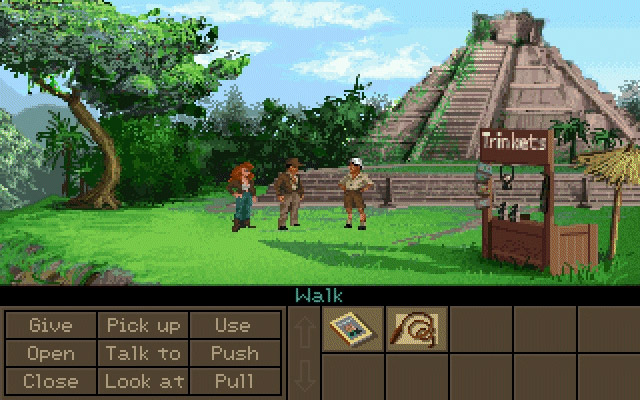
Fate
of Atlantis
game screenshot. |
|
Well, I saw all the movies. I went
to film school with George Lucas, I wrote Steven
Spielberg's first feature film, so I was up on
all the Jones lore. That is little help in designing
a game, however. It was really up to me to translate
this swashbuckling character's adventures into
game form. The only example I had -- a good one
-- was LucasFilm Games'
previous adventure based on the movie, The
Last Crusade. I spent a lot of time analyzing
how my pals Ron and Dave and Noah made it work,
and then pushed things a little bit further in
directions I liked.
Was there any feeling of pressure
on Fate of Atlantis,
knowing that it was based on a Spielberg series
of films, given that you had previously written
a film he directed?
No, none at all.
How much creative license and
control were you allowed on Fate
of Atlantis and what was working with Lucasarts
like at that time? Was there an approval process
for each stage of the game, lines of dialogue
or even specific types of puzzles?
I had no formal control; theoretically
Noah had approval rights, but we worked together
long enough for him to gain confidence in me,
and the issue never arose. I introduced action-y
minigame puzzles like car racing and camel riding,
and my new colleagues were doubtful, but supportive.
I guess the best way to look at it is this: when
they hired me, the company had an idea they wanted
me to use, based on a rejected script for another
Jones movie. When I read it, I thought it was
rejected for a reason, and together with Noah,
came up with the completely original idea for
Fate. The company
was overjoyed.
Sophia Hapgood has become the
most beloved character in the Indiana Jones series
that is not in a film. How did you set about creating
her? Give us some background into her genesis,
if you don't mind, and how you managed to set
her apart from Indy's film heroines.

Sophia Hapgood in the Fate
of Atlantis
comic. |
|
Well, Sophia is also one of my all-time
favorite characters. I like her slightly subversive
personality, her secrets, her toughness, her glamor.
She's a good match for Indy. I cooked her up because
we needed someone to interact with Indy on a continuing
basis. That's writing -- often ideas are very
nuts-and-bolts solutions to narrative problems.
I thought we could have her bear the central key
to the story in her mind-bending medallion and
also be his not-quite-trustworthy companion (and
possible lover). She's more of a driver of action
than any of the film heroines, but she's cut from
the same cloth as Marion Ravenwood, I think.
Do you have a particularly strong
or funny memory from your work on Fate
of Atlantis?
Well, nope, aside from the painful
memory of a lot of all-nighters.
There have been rumors circulating
for years that there was to be a sequel to Fate
of Atlantis called The
Spear of Destiny. Can you confirm this
and, if true, tell us a little about what this
game would have looked like and been about?
No Jones adventures are sequels,
they all stand on their own, in the same way that
Sherlock Holmes stories do. There's a continuing
strong central character of well-fixed attributes,
and we see him tested in a variety of circumstances.
Spear of Destiny
was going to be one of these, directed from inside
the company but built by an outside studio. LucasArts
hadn't yet figured out how to make that arrangement
work, and the project was cancelled. Didn't Dark
Horse publish a comic book?
Infernal
Machine is quite different in format and feel
from Fate of Atlantis.
What are your feelings on that change in format?

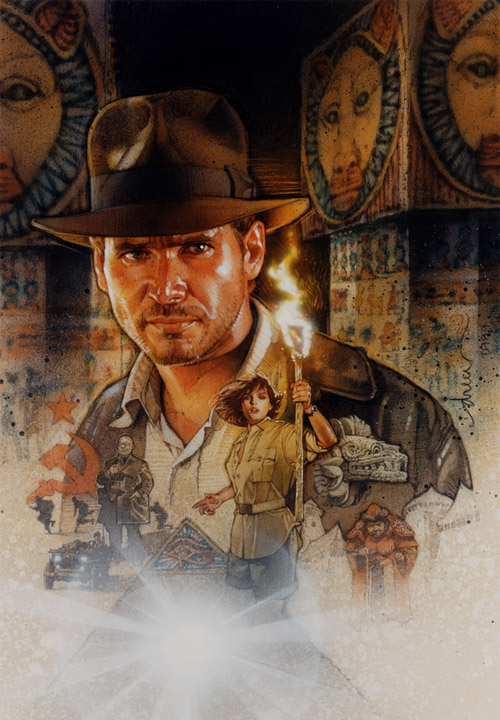
Infernal
Machine
poster. |
|
Well, I had something to do with
that: it's action-adventure, my kind of game!
So, I loved it, of course.
Did you like the game engine
advancement or not?
Well, sometimes I learn lessons
the hard way: never build an engine and a game
at the same time with the same team. We did, and
it was a painful experience. The results, though,
are good, I think, even though the pre-quaternion
animation looks hideously dated and we could only
render something like 5000 polys per frame.
How did you arrive at the story
for Infernal Machine
and what was different about its development compared
to Fate of Atlantis?
I chafed at the idea of doing another
Jones game with Nazis. They seemed stale after
much overuse. So I vaulted Jones forward into
the cold war and set him against the Russians.
Originally I wanted to have Jones go after flying
saucers, but word came back to me from on high
-- "don't go there." I wonder why not?
So I kept the cold war, kept the Russians, but
veered the prize away from UFOs toward Babylon
and an imagined technological marvel hidden in
the biblical Tower of Babel. Oh yeah, and I brought
back Sophia as a CIA agent -- perfect!
Fate
of Atlantis continues to rank at the top of
Indiana Jones gaming charts and also at the top
of the best adventure games charts for years and
years. What are your thoughts on the longevity
of this title and do you know if we'll ever see
it adapted to run on modern operating systems?
I'm enormously flattered by the
prolonged interest in this creaky old thing. I
hope fans can find ways to keep it running as
operating systems change, but I doubt anyone at
LucasArts would
ever want to bring it up to speed. It is what
it is -- a wonderful example of almost pre-historic
electronic gaming. I Wince when I stare at those
pixels, but I'm still proud of it.
Can you tell us anything about
what you are working on today and tell us your
thoughts on how gaming has changed from the days
of Fate of Atlantis
to now? Which era do you like working in more
- the games of today or are you at all wistful
for the days gone by?
For the first time since Fate,
I've been working on an adventure game -- Mata
Hari. It's a thoroughly modern point-and-click
title about the not-quite-so-modern era of espionage
in the First World War. A melodrama. Aside from
glancing at the history books for research purposes,
I don't look back.
What did you think of Indiana
Jones and the Kingdom of the Crystal Skull?
I thought it was great fun. I just
finished watching it again on DVD. I only wish
it were darker and spookier.
And finally, when you're not
designing video games, what do you like to do
for fun?
I read, I play with my grandchildren,
I ride my bike a lot...and then I get bored and
start working on little Flash games. It's a disease. |