|
The scene in which Short Round, behind the wheel of a Duesenberg,
rescues Indy and Willie began the film's production,
as part of the second unit work under Mickey Moore,
who shot Raiders'
famous truck chase. Mickey, along with Vic Armstrong
and Glen Randall, traveled to Macao to shoot the
chase through the Shanghai streets the very first
week of shooting, a week before principal photography
in Sri Lanka. He did all that with doubles, everything
from Indy and Willie coming out of the nightclub
window, through the blinds, into the car, and
up to the shot prior to their approach to the
airport.
April 18, 1983 found cast and crew
on the tropical island of Sri Lanka, formerly
the British colony of Ceylon, drinking champagne
and wishing good luck to each other.
Marshal remembers, "When we
arrived in Sri Lanka, it was like a great reunion;
we had almost all the same crew there. The same
production people, transportation people, same
caterer, those sorts of things. We also had Indiana
Jones again, so we were starting out on a completely
different level than before. We all knew what
kind of a movie it was what the atmosphere and
spirit should be, who the character was. So it
seemed like we were starting on the first day
of Temple of Doom where we'd left off on Raiders."
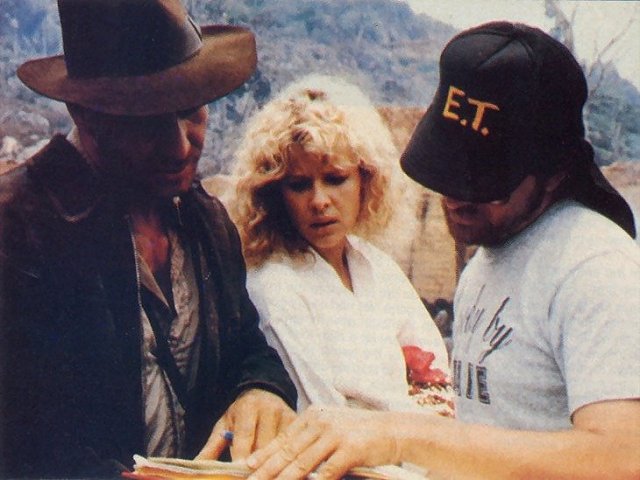
Ford, Capshaw and
Spielberg discussing. |
|
Being one of the only two people
who hadn't worked on Raiders
Capshaw felt like an outsider during the
first two weeks on the set in Sri Lanka. "There
I was very far away from any place I had ever
known, with people who all knew each other and
seemed to really know what they were doing. I
really felt they were checking me out that I was
on approval and had to prove myself to them. After
the second week, Frank Marshal and Steven took
me aside and explained everything, made sure I
felt like one of the gang. They're really just
very wonderful people."
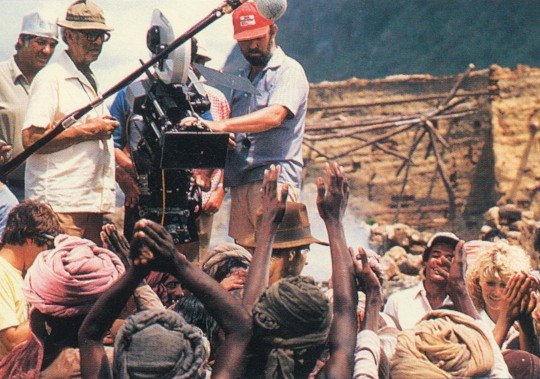
The Mayapor village sequence was
shot at the Hantane Tea
Estate located on the hills above their
base of operations near the city of Kandy. The
plantation was lying in the midst of coconut groves
and mining caverns - a steamy wilderness right
out of H. Rider Haggard or Edgar Rice Burroughs.
Tea fields surround the area; most of the world's
supply grows on the island, and major companies
such as Lipton
have established local headquarters. Local workers
constructed the village, under the supervision
of Elliott Scott, consisted of about twenty clay
houses including a water wheel. Clay cracks wonderfully
when it dries and the effect was excellent.
 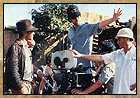 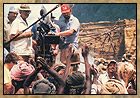
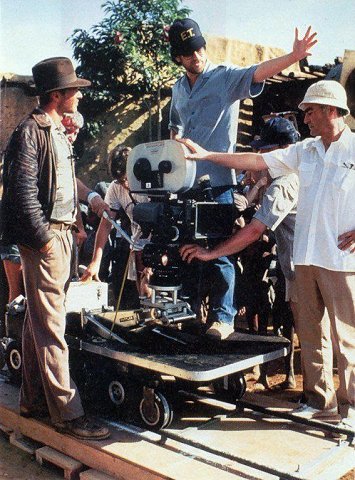
Filming Indy's arrival
at the Mayapor village. |
Situated above the outpost of Kandy
in the provincial hinterland, the plantation's
location caused problems in transportation. Because
the large trucks could not get up the narrow mountain
roads they were forced to use smaller trucks.
Three trucks for every one that they normally
used. And in the end they had a convoy of some
hundred vehicles. To further complicate matters,
it is nestled in a narrow valley between sheer
cliffs; the only accessible road spirals up a
mountain for 45 minutes before reaching the production
site.
No existing hamlet was feasible
due to the transformation, which occurs during
the film. Desolate when Indy arrives because the
life-endowing gems have been swiped, it becomes
a vigorous mecca when the jewels are returned.
This prosperous look was shot for scenes at the
film's end; earlier footage required setting,
the place town on fire!
To achieve the proper look of devastation
they had to torch the tea foliage on the hillsides,
and parts of the village.
The production left little to chance
as the scrub brush and healthy tea plants are
set ablaze with handheld torches. Fire extinguishers
and an emergency team were on stand-by alert in
case of mishap. The burning was handheld with
no problem and shooting commenced.
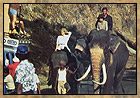
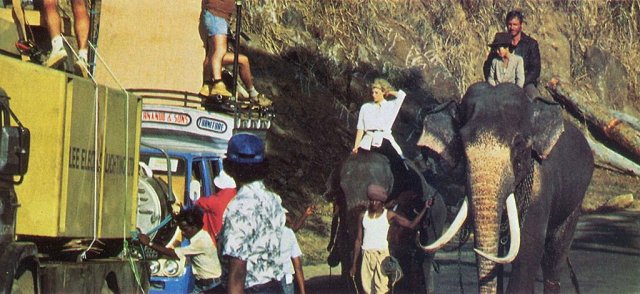
Elephants are coming! |
|
An elephant "orphanage"
located in Kandy, 40 miles from the shooting site
provided the wild pachyderms the production needed.
Three grown bulls and an infant were temporarily
"adopted." Transportation for the animal
actors was another matter.
"The elephants had to walk
from one location to the next," Watts explains,
"and their average speed is only six miles
per hour." Besides costly delays in awaiting
the beasts' arrival, production had been halted
occasionally because of their innate sense of
quitting time.
"They know when to stop,"
the exasperated producer groaned. "They have
a time for work and a time to quit and lie in
the sun. It's very difficult to convince an elephant
to work when he know he should be done for the
day."
The mammoth animals were less than
ideal in other respects, too. Elephants are difficult
to ride because they have huge, broad shoulders
that require tight straddling. Astride the beasts
for hours at a time, when the cameras finally
stopped rolling Ford would drop from the animal's
neck and collapse in a heap under the nearest
tree saying, "Those brutes are harder to
ride than camels." During pre-production
Lucas and Spielberg had asked Ford: "We're
thinking about setting this film to the jungle.
Is there anything you care for or you don't care
for?" and Ford replied, "You guys do
whatever you want but for this picture I think
we should have elephants." This was an idea
Ford had already started to regret.
"Riding an elephant is very
uncomfortable. I developed an antipathy towards
elephant riding. You ride with your lags in a
hyper extended position to accommodate the girth
of the animal right over its shoulders. First
one leg, then the other is pulled forward, which
tends to spread you apart-like being stretched
on medieval rack, I imagine." He later quipped
to the New York Times:
"The only fun thing about riding an elephant
is getting off!"
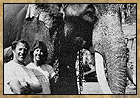 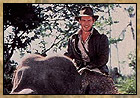 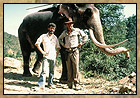
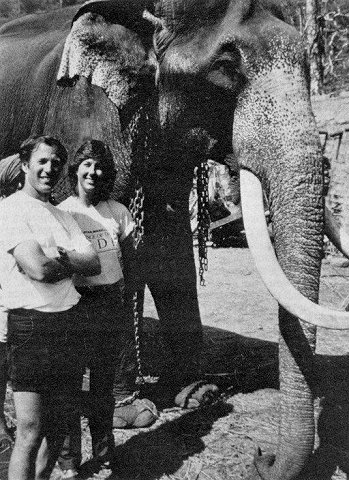
Kennedy & Marshall,
Ford and Lucas with the elephant. |
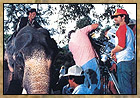 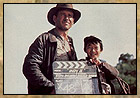 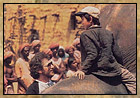
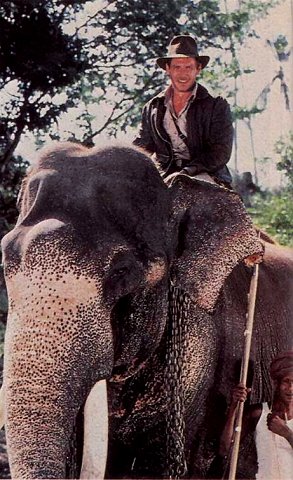
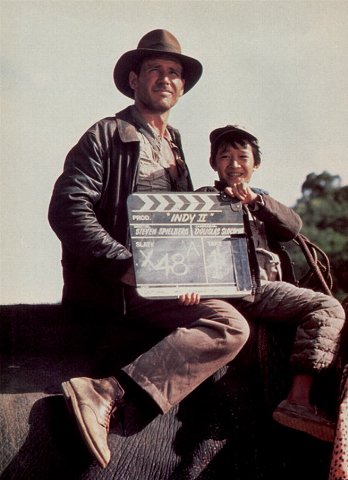
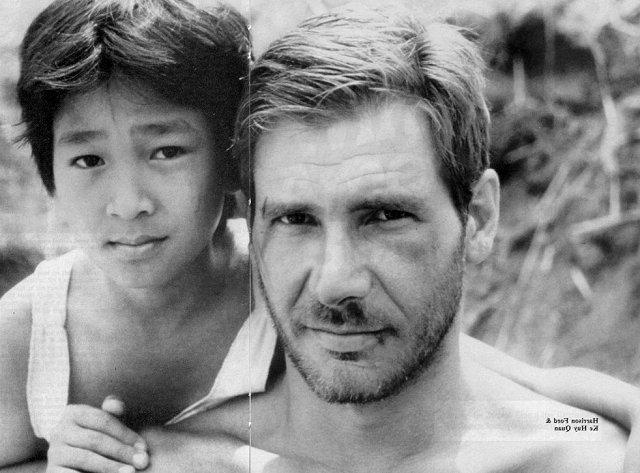
Harrison Ford
and Jonathan Quan at work. |
Theoretically Watts had timed the
production's arrival to coincide with a period
between two regular monsoons. During his visit
shortly before filming he discovered the waters
were heavily polluted, he even took samples that
proved unacceptable. By the time shooting started
the first monsoon hadn't hit and there had been
a drought, which resulted to the water levels
being dropped about 75%. For the scene where Willie
falls off an elephant into the river, they had
to create a pool and fill it with fresh water
ferried up in tankers to ensure Capshaw wouldn't
get sick. Despite Watts miscalculation they only
experienced one serious tropical thunderstorm.
They were up in the mountains at the village attempting
a night shot, standing around waiting for the
sun to set, waiting for the twilight. The caterers
were just serving out chicken and baked beans
when it hit. A cloud descended over the hill from
nowhere and broke into a deluge. The lighting
was spectacular, the thunder deafening. Everyone
scattered to their cars for shelter and get out
of the mountains before the roads became impassable
while a desperate Watts waved at everybody shouting
'Wait a minute, just a minute 'til this shower
is over and we'll get on with the shot.'
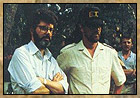
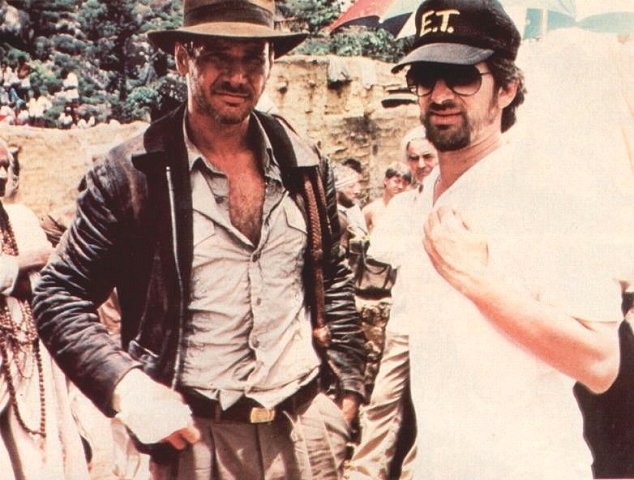
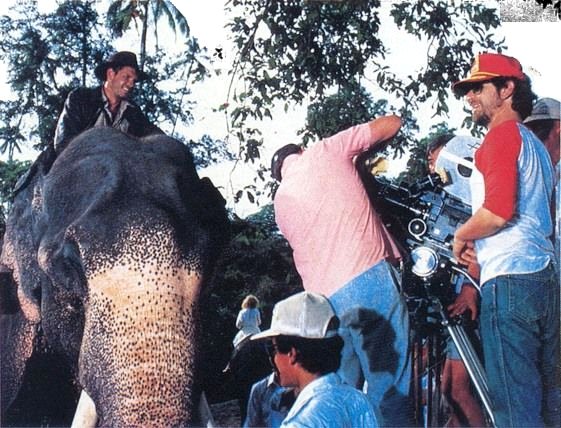
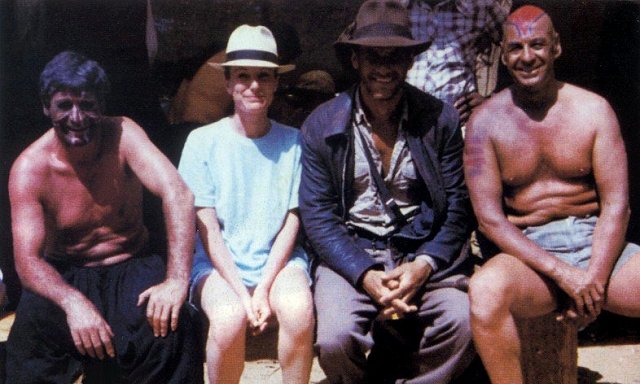
Between takes. |
|
There was a scene in which a snake
slithers out of a tree, into a pool where Willie
is bathing and wraps itself around her. The funny
thing is that the Sri Lankans aren't very partial
to snakes. So the production booked the pythons
Mike Culling had brought over from England into
their own hotel room adjacent to his under the
name of Mr. and Mrs. Longfellow! When time came
to shoot the scene Capshaw couldn't do. They had
trained the snake for weeks in advance; she had
been trying to psych herself up for this scene.
She said when she touched the snake the first
time it undulated and she thought she was going
to die. She started sweating. Then, they tried
to put the snake on her shoulders to show her
what it would be like, and she just totally freaked
out. Steven was ashen and said, "That's all
right. Ok, if you're not going to do this, there's
no way you're not going to do the bugs!"
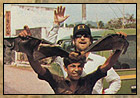
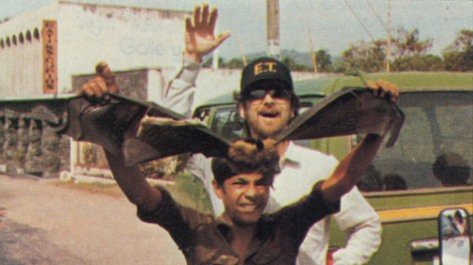
This is a real bat folks! |
|
Other members of the animal kingdom
employed in this film were bats. Strange, ugly
creatures the giant fruit bats that lived in the
trees in Kandy would sleep all day, folded up
in trees, looking like some weird foliage. The
crew couldn't get too close to them because of
the danger of rabies, although they were fruit
bats, they were big and they would bite anything
in self-defense. To get a good shot of a swarm
of them the crew, led by Frank Marshall, let off
a firecracker. The trees would be barren as they
came swooping around, real unhappy at being disturbed.
There was a small part in the script
for a child who has escaped from the mines of
Kali and gotten back to the village. It's the
arrival of this child that persuades Indiana Jones
to visit the Palace of Pankot. Spielberg wanted
to cast this part with a local child, so eventually
they brought up three kids from Colombo, the capital
of Sri Lanka, who's had some experience in acting.
While they were testing them on the set, they
noticed a boy sitting on the wall, watching, taking
everything in and looking very keen. They asked
him down to try out too. He turned out to be the
best of all. He was the son of a local woman who
picked tea on the plantation. A kid who lived
in a mud hut. He proved to be absolutely amazing;
he hit his mark every time and even had a couple
of lines.
Ford's proficiency with the bullwhip
was again proved to be valuable, completing the
Indian swordsmen scene, for instance, in one take.
"He could shave George Lucas with that whip",
confided a crewmember.
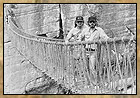
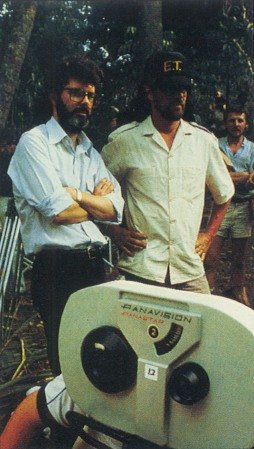
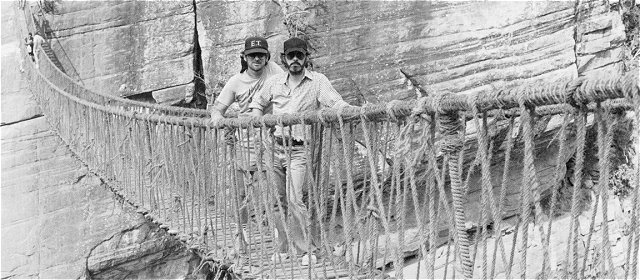
Spielberg and Lucas
on the rope bridge. |
|
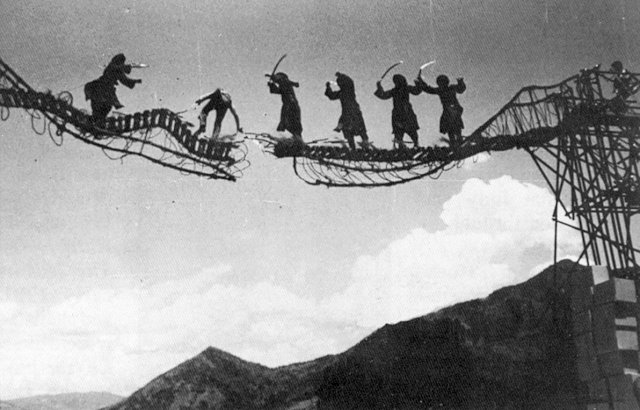
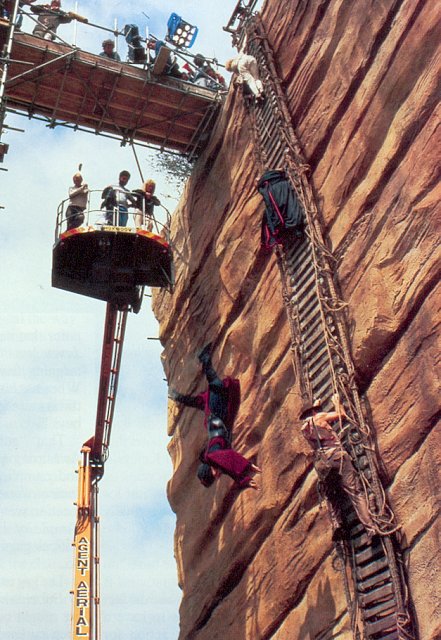
The last sequence filmed in Sri
Lanka was the one where Indy is in the middle
of the rope bridge with enemies in each side of
it. The bridge was constructed with the help of
a British engineering company that was building
a large dam in a nearby canyon. Their help was
very valuable and saved the production from money
and man-hours. The 18 inches wide bridge, that
took four weeks to build, was actually made of
steel and cable that afterwards had been camouflaged
with ropes and wood in order to look unstable
and dangerous for someone to cross. Although the
bridge was safer than it looked, the fact that
it was swaying precariously 250 feet off the ground
made it very dangerous. Safety precautions had
to be taken but as days went by cast and crew
tent to familiarize themselves with the situation.
"After you've been there for a day, the crew
- 50 or 60 people total - gets very familiar with
the danger and tends to forget to put the safety
lines on. So, you've always got to go around saying,
'Put the safety harness on, put the safety harness
on,'" recalls Watts.
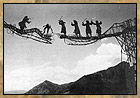
Stunt legend Vic
Armstrong at work. |
|
Cutting the bridge wasn't as easy
as it looks on the screen. Mechanical effects
supervisor George Gibbs had to device a way to
cut the steel cable on the rope bridge without
any sound and without any smoke from explosions
because the plot called for Indiana Jones to cut
the bridge with a sword. Gibbs turned to a company
in Marseilles, France, called Pyromecca,
which specialized in pyrotechnic releases for
space capsules and things like that. They designed
and made, especially for him, these cable cutters,
which were no bigger than a normal paper teacup
and had the power to cut through 19-millimeter
cable without any noise. The cutters have a slot
in the bottom, where you hook them over the cable
-that's called the anvil. Inside that, there was
a high tensile steel chisel. Above the chisel,
there was a small amount of explosive -it was
no bigger than a thumbnail, but that explosive
power is enough to drive the chisel through a
steel cable 19mm thick. When the day came to actually
film the scene Gibbs had made preparations down
to the last detail. The night before, he said
to Spielberg, "Whatever happens, if we want
to stop the cameras, we mustn't shout out cut,
in case I'm nervous'".
To add more realism to the scene
Spielberg said, "I've got this shot: I want
to look along the bridge, and when the bridge
cuts, I want to see all these men throwing their
arms about, waving their swords." That happened
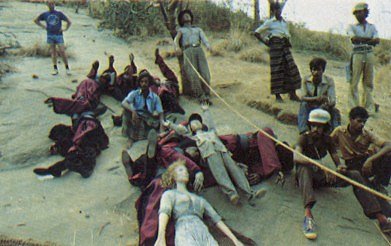
about eight weeks before hand. So Gibbs took about
16 ordinary tailor's dummies, made molds of them,
and tilled the molds with soft foam. Internal
pneumatic air cylinders were triggered, causing
the dummy limbs to flail about, perfectly simulating
human movement. In England's EMI-Elstree
Studios there was a big tower, about 70
feet high, created for the film Greystoke. They
were dropping smoke pots off the top, to simulate
a volcano. Every other day, Gibbs and his team
went up the tower and threw a dummy off to check
it and videotape it. They would send the video
off to Spielberg and he would say, "Can you
make the head and wrist wobble a bit more?"
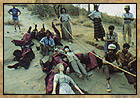 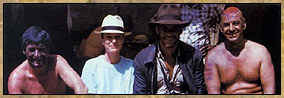
The dummies opposite
to the stunt doubles (notice Ford in the middle). |
Ford's daredevilism continued and
refused a stunt double once again. So when one
of the crew members asked him how he would find
the courage to stand in the middle of the bridge,
Ford rubbed his chin and repeated a line from
Raiders: "How
should I know? I'm making this up as I go along".
Ford had convinced Spielberg that he wouldn't
be in danger, and so he took his position in the
middle of the bridge. "So before anyone could
do anything, I just run across it. In fact, it
was dangerous as hell". When asked about
doing stunts Ford answered: "As long as I
can still fall down with some reasonable assurance
that I'll get up again, I don't worry." But
later he expressed a secret desire; "I'm
almost looking forward to getting older parts
that won't call for me to be bounced off walls
every ten minutes."
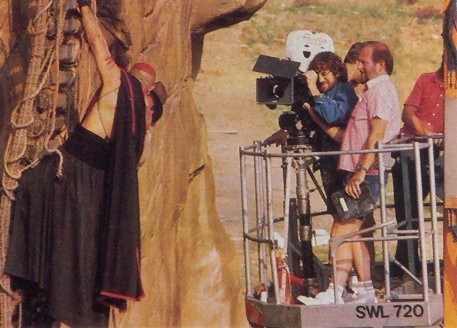
The bridge scene could only be shot
once. Nine cameras were trained on the action.
"We had every camera we had -nine cameras
out. And it's one go, and that's it. It was over
cast, and we had everything ready. The assistant
director, David Tomblin, timed it perfectly for
a hole in the clouds when the sun came out. We
rolled all the cameras -you must wait for each
camera to report in to make sure they're all running,
and then you go", said Watts. They had to
have the sun out for the bridge would blend into
the countryside because otherwise the bridge would
look one-dimensional flat against a one-dimensional
background. So they had for the effects to be
right and safe to wait for the sun to come out.
The filming of the scene would be completed in
Elstree studios
where another bridge was built for close-ups of
the principal actors being hanging. This one was
only fifteen feet above ground.
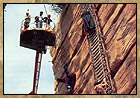 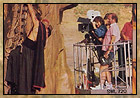 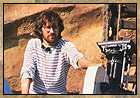
On the rope bridge
set at Elstree
Studios in
Great-Britain. |
Spielberg always thought that the
old Hollywood serials, taking place in some jungle,
featured sounds created by someone at the studios
but when he went on location he realized his mistake.
"I was astonished at the amount of noise
in the Sri Lankan jungle. I had always thought
those jungle sounds were created back in 1929
by the MGM
sound effects department! Part of the soundtrack
on Temple might be interpreted as sounding cliché
because we have all heard those jungle sounds
in so many old motion pictures like Tarzan
the Ape Man. But, in fact, those are the
sounds of Sri Lanka, the sounds of the jungle.
The Macao location was very different and rather
difficult because it was simply a car chase through
vet narrow, crowded streets with limited light."
Watts, looking back at the location
filming said, "Sri Lanka was an eighteen-hour
flight, then a dreadful drive to get to where
we were set up. With Macao of course, you had
to fly to Hong Kong then take a hydrofoil boat
to Macao, a long, long way from home base London.
We were able to pick up a lot of equipment in
Hong Kong, they have a reasonably active film
industry, but in Sri Lanka almost everything had
to be sent from England. Including the catering
truck and refrigeration units. One of the most
important aspects, when you're shooting overseas
is catering. You spend a lot of money in import
caterers, cooks, and even foodstuffs -there's
a mobile kitchen truck, brought in by ship from
the UK or US depending on the location. This is
vitally important, because sickness among the
crew can wipe the production away. Although you
want to give the crew good food, which is one
side of the coin, you are also buying insurance
for the production against sickness. With Tunisia
the fault really lay there with ourselves and
circumstances, not with Tunisia. The time frame
for shooting had pushed the production into that
location at the hottest time of the year. It's
very difficult not to get sick when the temperature
is 130 in the shade. When we used the location
for Star Wars,
we were there in March/April when the temperature
is moderate, in the 70s. We didn't have any sickness.
You're always careful, in any country, but particularly
in the Third World countries - the standard of
hygiene may not be quite the same as one is used
to."
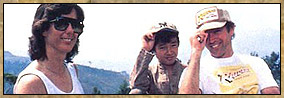 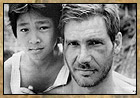
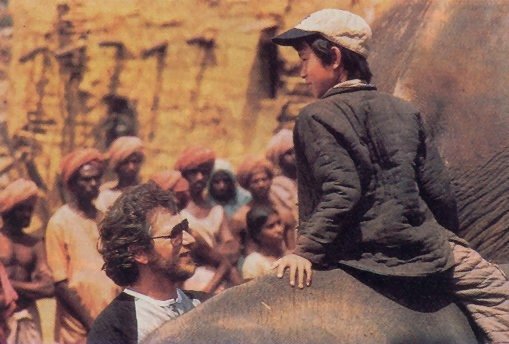
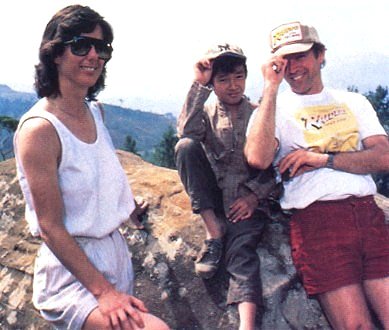
Jonathan Quan with
producers Kennedy, Marshall and Harrison Ford. |
Shooting on Sri Lanka lasted three
weeks filming mostly exterior shots. Although
the conditions were much better than those in
Tunisia were, the production crew followed a very
exhausting schedule working from 7:30 a.m. till
sunset for six days every week. Shooting schedules
had been changed to comply with child labor laws,
which meant that Quan must have an onset tutor,
and may only work three-and-a-half hours a day.
Young Quan had been taken under Ford's wing during
filming, personally coaching him and even teaching
the youngster swimming and how to use the whip.
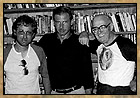
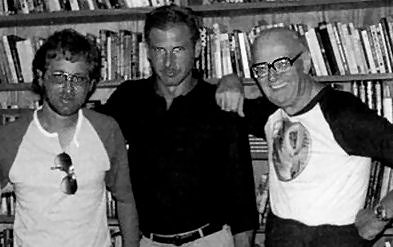
Spielberg
& Ford with novelist Arthur Clarke. |
|
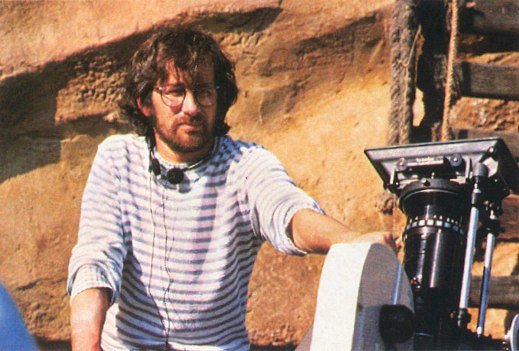
His natural ability to deliver a
line gave the director the key to a believable
performance. Rather than memorization, Spielberg
opted for spontaneity; he reads Shorty's lines
to Quan just before filming. The child actor then
repeats them in appropriate pidgin English for
the cameras. Midget Felix Silla, who played in
Back Rogers in the 25th
Century and an Ewok in Return
of the Jedi, substituted Quan appropriately.
Sri Lanka, the Pearl of the Orient,
was also the home of science fiction novelist
Arthur C. Clarke, whom Spielberg and Ford paid
a visit during their stay there.
Next: Indoors
adventures >> |