| Filming
took 73 days, just as planned.
Post-production lasted a couple
of months and was spent mostly
on special effects and pick
up shots.
Filled with virtuoso
stunts and exciting escapes,
Raiders
of the Lost Ark presented
very special challenges to the
special effects team of George
Lucas' Industrial
Light and Magic in Marin
County, California. Far away
from today's CGI effects this
enormously exciting action epic
was a hard act to follow since
they had such a difficult subject
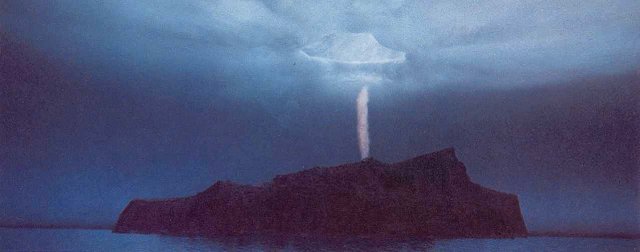
as to portray the wrath of God.
During pre-production
storyboard artists Ed Verreaux,
Dave Negron, Michael Lloyd and
Joe Johnston were asked to try
to imagine what would happen
when the Nazis open the Ark
for the first time. The script
described the scene by only
saying: "They open the
Ark and all hell breaks loose".
Though they knew that spirits
were involved Lucas and Spielberg
weren't sure how they should
appear on the screen. So each
of the artists did a preliminary
set of storyboard on their own.
One had come up with no ghost
at all and it was all firestorm.
Another artist had all ghosts
and no flame while the third
one had all these weird light
effects. Lucas and Spielberg
then asked that all three ideas
be combined and Johnston was
given the task.
With storyboards
completed Richard Edlund and
his team were responsible for
translating them into film.
The main question the team faced
was what does a real ghost would
look like, what would look believable
and scary. Of course, nobody
had ever photographed a ghost,
so the visual concept depended
on legend and their imagination.
ILM's
resources and personnel had
to be carefully divided between
Raiders
and Dragonslayer,
which was also in post-production
at the time.
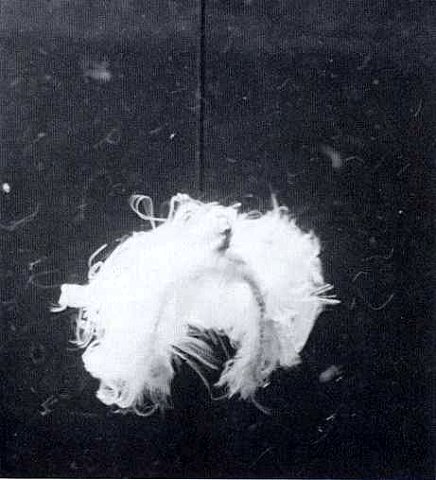
At first, it was
thought that the ghosts could
be created with cel animation,
but early tests soon proved
unsatisfactory. Edlund was searching
for something with a different
look. Eventually, the old cloud
tank used in Close
Encounters was refurbished
and tests were shot with small
puppet-ghosts in water. Several
elements were shot using the
tank to achieve the flow and
feel of ghosts as insubstantial
spectres floating and swimming
through the atmosphere. Although
there are four shots in the
finished film that make use
of cel animation to achieve
ghosts and ghost effects, the
bulk of the material was shot
using other techniques including
miniatures in the tank and full-scale
puppets and actors. Special
optical techniques were developed
to combine the ghosts with live
action footage giving a transparent
"look" that would
not look like a simple double
exposure or "burn-in."
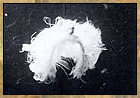 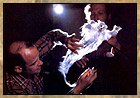 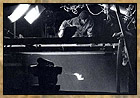
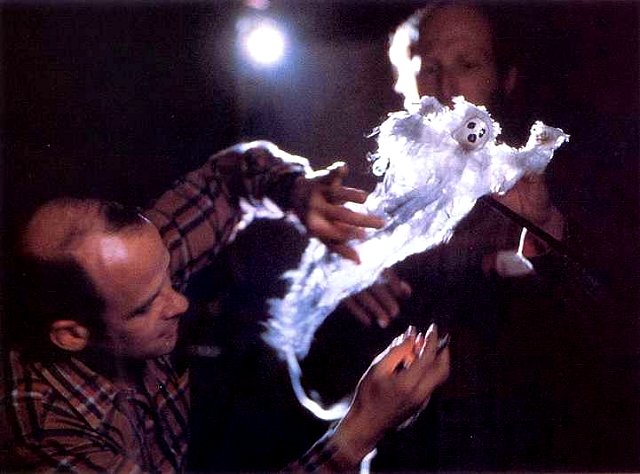
Preparing
small puppet ghosts for
in the old cloud tank. |
Cloud tanks were
developed by Doug Trumbull for
Spielberg's Close
Encounters and later
seen in the De Laurentis Flash
Gordon. For Raiders,
Edlund's team also generated
cloud effects in the tank, but
found other uses as with the
ghosts.
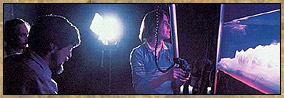 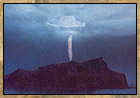
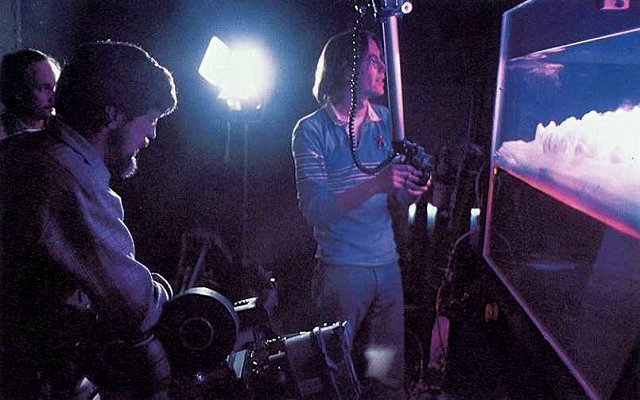
Making
cloud effects in the tank
and the result in the film. |
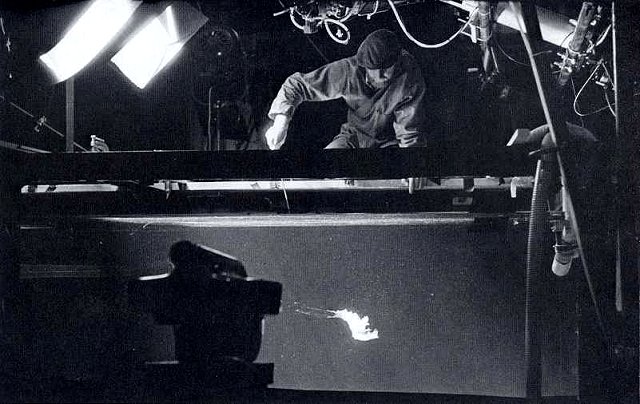
They created an
inversion layer in the tank
using different temperatures
and densities of solutions,
for example a layer of salt
water on the bottom of the tank
with a layer of fresh water
above it. Various pigments and
dyes could float in the plane
where the two layers meet thereby
generating different types of
cloud effects. They used what
they called an 'atomic arm'
(a remote-controlled hand, such
as the ones used for moving
isotopes in nuclear laboratories)
to squirt pigment into the tank
at the appropriate level. It
is designed so that someone
can control the insertion of
the pigment from back near the
camera, so he can see pretty
much what the camera sees as
he makes a shot.
For the death of the villainous
trio.
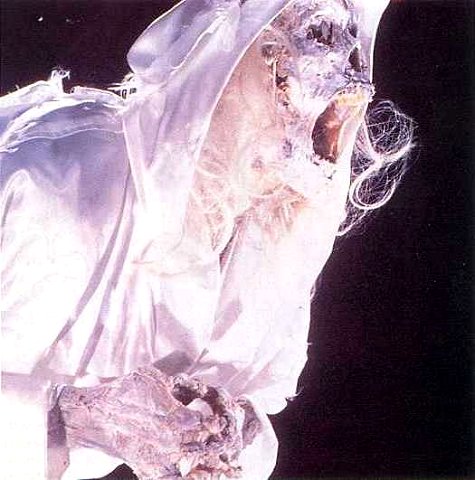
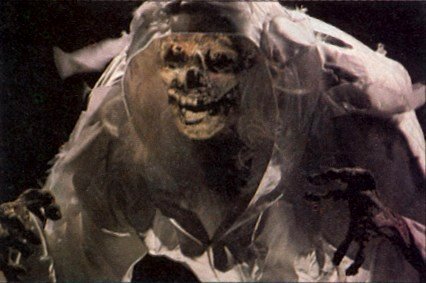
The most startling
shot in this sequence occurs
just before the debacle, when
one of the wispy manifestations
drifts up toward the camera
to reveal a rather angelic-looking
female countenance which then
suddenly transforms into a ghoulish
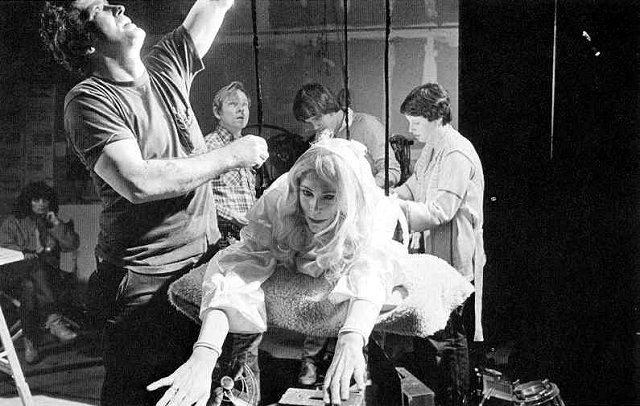
death's-head. A woman dressed
in a white flowing gown and
with white makeup on her was
placed on a platform that was
hanging from three wires and
was filmed in many movements.
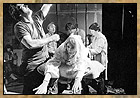 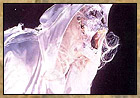 
From
a beautiful white female
to the ghostly demon. |
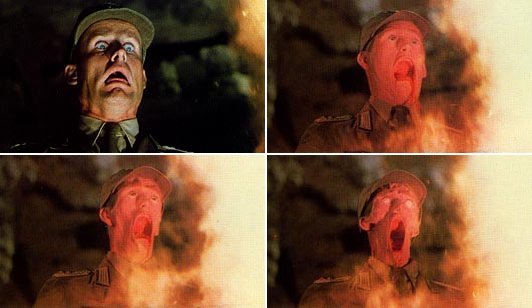
Once the transformation
from angel to demon has been
effected, the full fury of the
awesome forces within the Ark
is unleashed against the Nazis
violators. Flames leap forth
from the open chest, and in
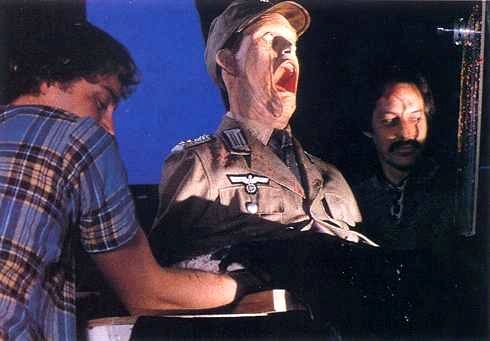
a matter of moments, Dietrich's
face shrinks to a mummy-like
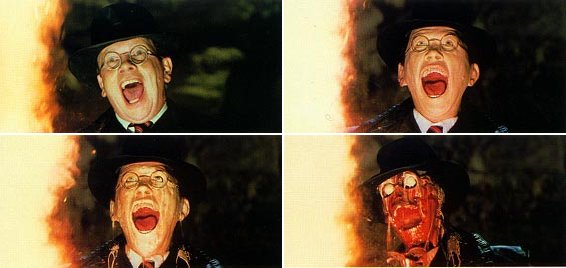
visage. Toht's features melt
away from his skull, and Belloq's
head explodes into a pulpy mess.
Spielberg had decided that the
villains should be disintegrated.
The storyboards dictated close-ups
of Belloq, Toht and Dietrich
with their faces shutter and
crumble away but after many
efforts and thoughts they realized
that they couldn't do such a
thing, so instead of disintegrating
them they decided to give to
each of them a different kind
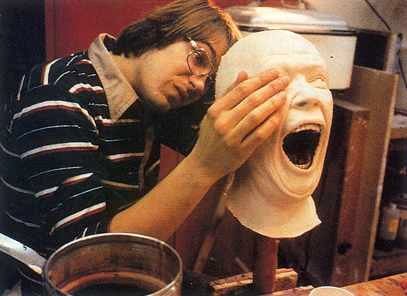
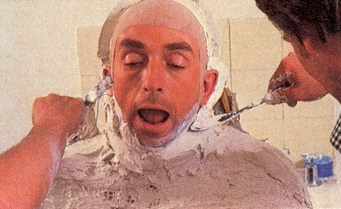
of death. Life molds of the
characters in the screaming
positions they would ultimately
reach had to be taken. They
had them hold their positions
while they took castings of
their faces and then special
make-up artist Chris Walas had
to rebuild their faces from
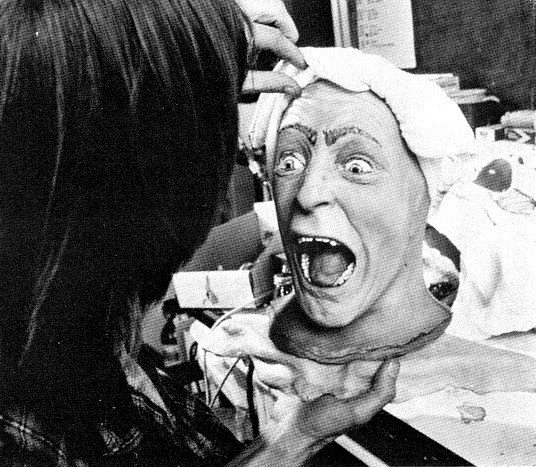
the molds. Walas produced a
series of three artificial heads.
The first, representing Colonel
Dietrich, employed inflatable
bladders which when pumped up
with air, sustained the face's
proper shape. Joe Johnston's
hand was used during shooting
in the close-up to impart some
added life to the scene. When
the air was sucked out, the
bladders deflated and the face
became instantly mummified.
It took eight or nine people
to control the effect, manipulating
different levers inside the
head, all of which had to be
done on hand.
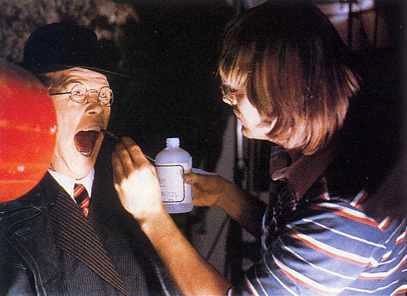
Toht's head was made from a
multi-layered gelatin compound
and was filmed in time-lapse
as it melted down the skull
from the heat provided from
a dryer. The time-lapse for
the melting head was shot at
a little less than a frame a
second.
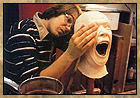 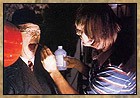 
Working on Toht's crumbling's
face effect. |
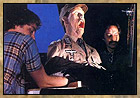  
Dietrich's face melting
away. |
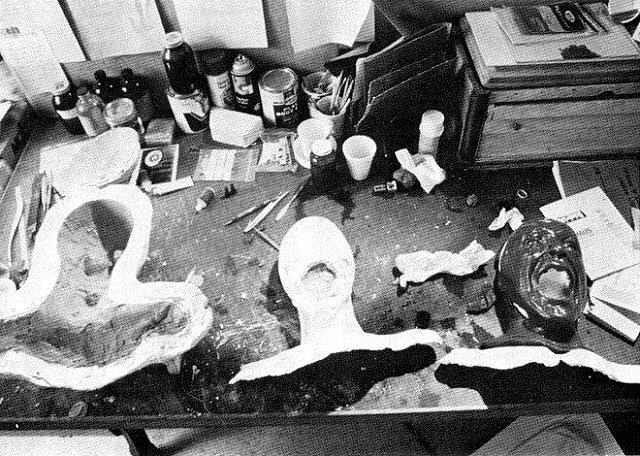
In the case of
Belloq they blew his head up
by using a sort of plaster skull
with a pliable substance over
it to built the sculpture up.
The final effect for Belloq's
head employed a large air cannon
directly in front and below
the head, two shotguns placed
about fifteen feet or so behind
the head and off to the sides
and explosive charges. Then
they used four or five pieces
of primer cord to sever the
neck and three different dets
under the eyes and chin. Inside
the head Thaine Morris, who
handled all that with the assistance
of Ted Moehnke, had placed a
very thin plaster skull, which
they filled with blood bags
that had all kinds of garbage
in them - dried latex, vermiculite,
pieces of foam etc. The head
had to be blown up three times
before they got the desired
effect turning the stage in
an absolute mess. Since the
exploding head was to lead directly
into the holocaust shots the
optical department decided to
superimpose pyrotechnic effects
to help detract from the gore.
The pyrotechnics, which were
put in front and in the back
of the head, were being exposed
more than the exploding head
itself with out losing the impact
of the effect. A certain amount
of optical work was done on
all three shots, which included
matting fire on one side of
the frame.
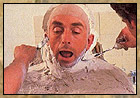 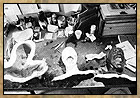 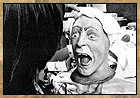
Constructing Belloq's plaster
face. |
While one part
of the Raiders
effects team was busying themselves
creating elements for the film's
breathtaking conclusion, others
began with the comparatively
few effects shots that occur
elsewhere in the film. One of
the earliest in the film is
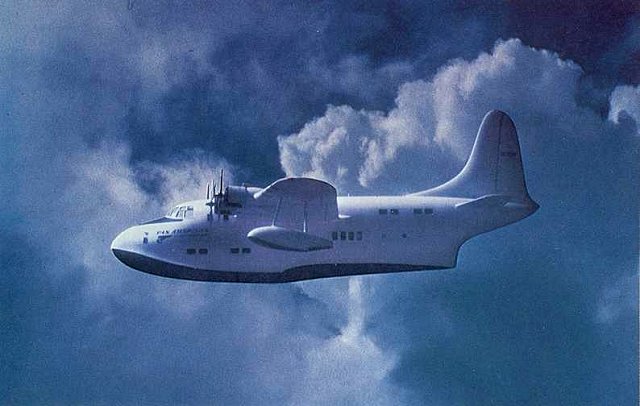
the shot of the China Clipper
that Harrison Ford boards for
the flight to Nepal.
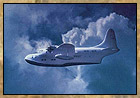
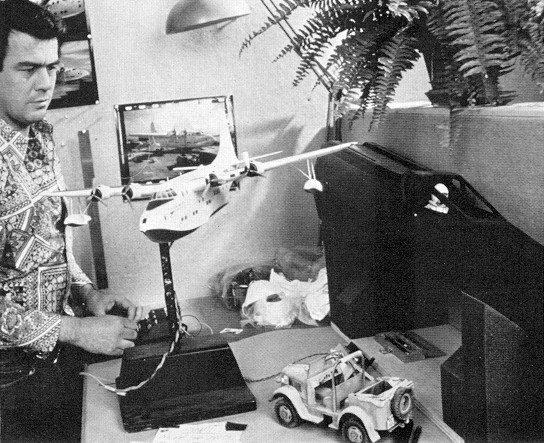
The Clipper in the
film. |
|
They knew that
there was only one similar seaplane
in the world that could still
fly. But it was located in Puerto
Rico and due to budget constrains
they couldn't go there. As luck
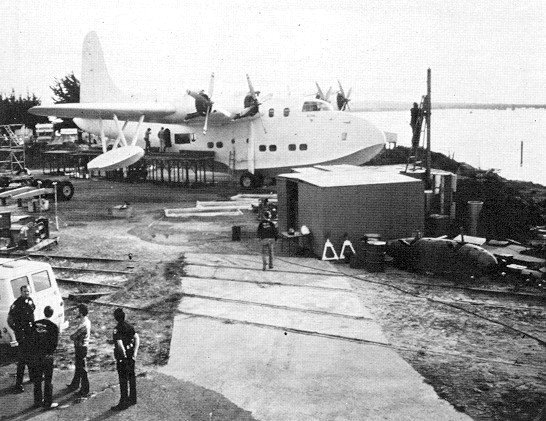
would have it, they found an
old flying boat that was in
a shipyard about five miles
from lLM.
It wasn't a real China Clipper,
but it was close enough - a
four- engine passenger seaplane.
It was on dry land and could
not float. So they built a ramp
next to the plane to suggest
a dock and placed pans of water
on the ground to reflect a moving
water effect underneath the
wings. Actors were dressed in
appropriate 30s costume and
filmed boarding the plane and
then the only working engine
would get started to add some
realism.
Then they took a helicopter
trip around the bay to find
a pier that would look right
for the foreground of the shot.
They found such a pier on Treasure
Island and made a deal
with the Navy to film there.
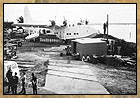 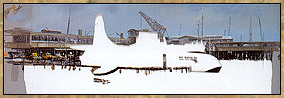
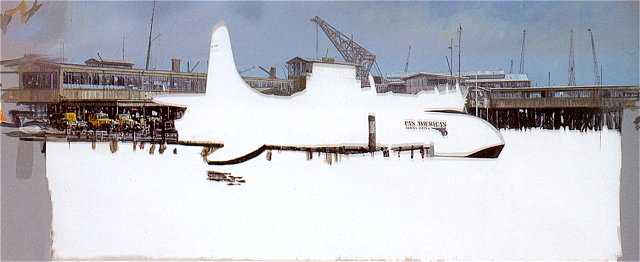
The
real Clipper in the shipyard
& the boarding dock
matte painting. |
The completed
shot is made up of two separately
photographed plates and a matte
painting of the seaplane base,
taxicabs, etc. tying the elements
together. There was the plate
of the pier, the plate of the
seaplane and the matte painting
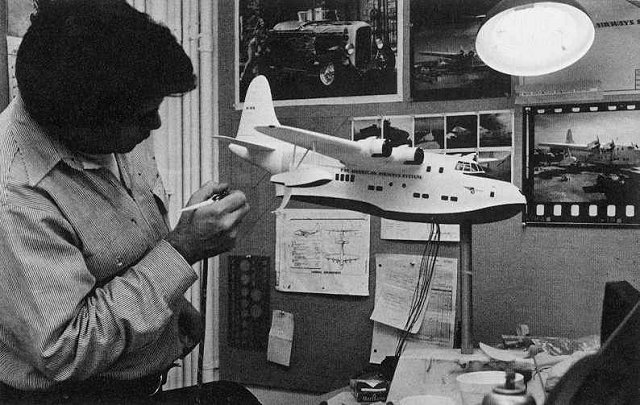
by Alan Maley. Subsequent flying
shots, photographed by Jim Veilleux,
were done with a miniature replica
of the plane built by Mike Fulmer.
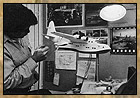 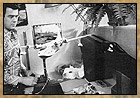 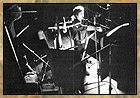
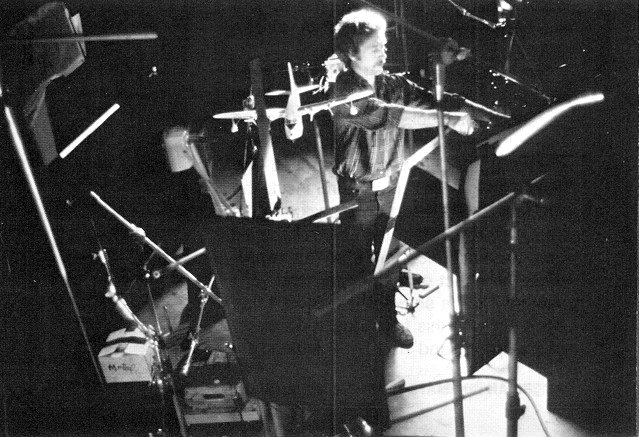
Making
the miniature replica of
the Clipper and preparing
it to film. |
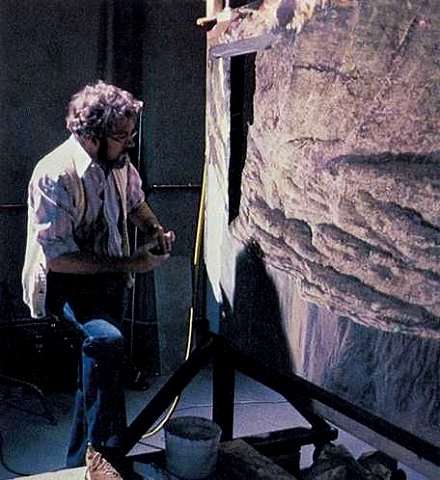
One of the most
popular shots in the film was
the shot at the end of the truck
chase sequence with the Nazi
car flying off the cliff. It
was a cooperative interdepartmental
effort. The cliff was a matte
painting by Alan Maley, photographed
by Neil Krepela. The animation
of the Nazis and the car was
handled by stop-motion artist
Tom St. Amand with Jim Veilleux
as cameraman.
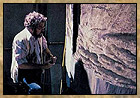
Cliff matte painting. |
|
First a test pan
on the painting had to be shot.
The live-action plate was rear
projected into a corner of the
painting as the matte camera
recorded the plate and painting
with a slight pan of the matte
camera to suggest the effect
of tracking with the falling
Nazis. This test footage was
taken over to the miniatures
stage and used as a guide to
shoot the miniature car and
Nazis. The match-up of the matte
painting and the stop-motion
miniatures was done by eye.
The stop-motion miniatures were
shot against the standard blue
screen backing. Later, Bruce
Nicholson's optical department
went through the necessary steps
to produce an anamorphic holdout
matte of the car and Nazis.
This black and white travelling
matte film element went back
to the matte department just
about the time Alan Maley was
putting the finishing touches
on the cliff painting. Then
the matte department shot the
final take of the matte painting
with the live action rear- projected
into the corner window, but
this time the black and white
travelling matte is running
in bi-pack in the camera. This
matte leaves a perfect 'window'
of unexposed emulsion for the
car and falling Nazi.
Finally, the optical department
took this 'held take' and exposed
the miniature car and falling
Nazi into the hold created by
the travelling matte in the
matte camera then the film gets
developed.
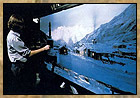
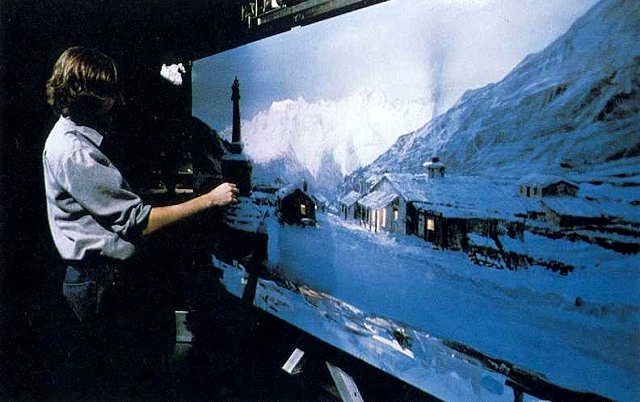
Nepal matte painting. |
|
In the original
script Kasdan embroidered dozens
of images to take the story
from one country to the next
- huge montages from San Francisco
to Nepal, from Nepal to Cairo,
from Cairo to the Mysterious
Island in the Mediterranean.
To save money and pay tribute
to the films that inspired Raiders
Spielberg decided to show a
map of the world with little
animated travel lines tracing
the route of our adventurers.
As Indy's plane flies to Egypt
a map with a red line moving
across it is superimposed over
the image. Such a device was
used in many old films, amongst
them Casablanca.
The shots of the mountains in
the background, according to
Tony Crawley, were rented from
the 1973 film The
Lost Horizon while the
exterior shot of Indy's house
is supposedly taken from The
Hindenburg, although
Richard Edlund maintained that
it was shot with miniatures.
The film's last
shot of Indy in the staircase
of the government building wasn't
in the script. It was Marcia
Lucas who after watching the
rough cut observed that there
was no emotional resolution
on the ending, because it showed
only Indy delivering the Ark
to the US government officials,
and Marion wasn't shown anywhere.
Spielberg re-shot the scene
in downtown San Francisco, having
Marion wait for Indy on the
steps of the government building.
Spielberg's first
cut had a running cut of approximately
3 hours but together he and
editor Michael Kahn cut it down
to something less than two hours.
When Spielberg
completed his version of the
film he voluntarily turned it
over to Lucas. Lucas filled
the screening room at Parkhouse
the first time he watched Spielberg's
cut, because he didn't want
to see it without an audience.
The next morning he called Spielberg
and told him, "I've got
to tell you, you're really a
good director". Later Lucas,
together with Kahn, cut seven
minutes out of the first half
of the film, making it more
tight, slick and fun. Spielberg
although he questioned some
changes he was pleased and impressed.
"I would trust George with
any movie I ever direct to edit
in anyway he sees fit. He knows
the secret of what an editor
can do to a movie, how he can
enhance the film".
Lucas had visited
the set of Raiders
many times, in fact he was on
location in Tunisia two of the
five weeks of shooting, three
of the nine weeks in London,
and throughout the shooting
at La Rochelle and in Hawaii.
Lucas claimed that he visited
the sets only to keep company
to his friend although many
believe that he did it to keep
an eye on his friend's job.
Lucas' presence was catalytic
in Spielberg's work. He was
there to drop ideas, while on
the other hand he provided the
required liberty that any director
needs. At the end of shooting
Spielberg told to Time
magazine, "Lucas was to
me what David O. Selznick was
to his directors on Gone
With The Wind. I respect
his comments totally. Raiders
proved that two people can make
a movie together and remain
friends". Indeed, the relationship
between the two worked as best
as it could for the film's interest.
When they would have a disagreement
they treated it with humor.
Lucas would say, "Well
it's your movie. If the audience
doesn't like it, they 're going
to blame you". And Spielberg
would answer, "okay, but
I'm going to tell them that
you made me do it", and
after that they would start
exchanging ideas to find solution.
During some pick-up
shots in the hold of the Bantu
Wind, where the Ark is being
carried we see the Ark surrounded
by rats. They had got the rats
so that they'd start to run
toward the Ark; and most of
them scattered to the corners,
which were dark, which was great.
But there was this one rat that,
all of the sudden, ran toward
the Ark, and then stopped and
started turning around in circles.
It just kept turning in circles,
which was perfect, because it
looked like the hum from the
Ark was hurting its ears. Richard
Edlund and Kathleen Kennedy
were dying because they didn't
know what was wrong with it.
They found out from Mike Culling,
the animal trainer, that he'd
had the rat since it was a baby,
and it was deaf and also had
an equilibrium problem.
The film's score
was composed by renowned composer
John Williams who Lucas and
Spielberg had used in almost
every of their previous works.
He had allocated themes to people,
and symbols, with some distinct
separation. The Ark: this is
religious, orchestra and chorus
but using the two as one sound;
you won't hear the chorus. Indiana
Jones theme: this is a heroic.
Marion's theme is a recurrent
love theme. The baddies theme,
the Nazis, etc is dark music.
Those are the four main themes,
which recur. There is a fifth,
almost a set piece within the
main music and related thematically,
for the scene with the monkey
and Marion and Indy in the Cairo
street. This was Spielberg's
idea. He was trying to have
a kind of "As Time Goes
By" feel, a '30s attitude.
Much of the atmosphere in the
old serials was evoked by the
score. John isn't as familiar
with the music of the old Republic
serials as I am. Johnny is essentially
a classicist and a lover of
Victorian and Elizabethan sound.
Johnny isn't a "pulp"
composer and I'm not a "pulp"
director, but this is a "pulp"
movie. But Johnny watched the
film and saw that it was a very
realistic kind of movie on one
hand with a sort of pulpish
treatment; he was not about
to compose a score for this
as he would compose a score
for, say, Bridge
on the River Kwai. By
the same token Johnny's music
has a seriousness, which is
important; I wanted a serious
score, which is what he gave
me. For Raiders
Johnny and I discussed some
sort of a march, something you
could walk out of the theater
whistling. The Indiana Jones
theme has a lot of whistle value
and the Marion theme is right
out of the Warner
Bros. Classics - a cross
between Dark
Victory and the love
scene from Casablanca.
Next:
The great adventure returns >> |